
5+1 destinations for an October getaway in Greece

October is the ideal month for all travelers visiting Greece for an alternative vacation opportunity, seeking to discover what a place really has to offer, other than the golden beaches and the emerald waters. It is, however, that time of the year for everyone who looks for something different, who is in search of something more adventurous, immense and perhaps just breathtaking. Here are 5+1 destinations for your October getaway in Greece that you should hit next!
1. Zagorochoria: the spot beyond the mountains

Autumn colors in Zagorochoria villages
The 52 villages in the region of Epirus, northeast from Ioannina, will make your travel one of the most extraordinary experiences. The first thing you’ll notice is that, once you step your foot in the region, you’ll instantly become one with nature. Surrounded by forests and rivers full of intriguing flora and fauna, kind and hospitable people and wonderful house buildings made from stone, the villages are gems hidden in plain sight for those ready to discover them.
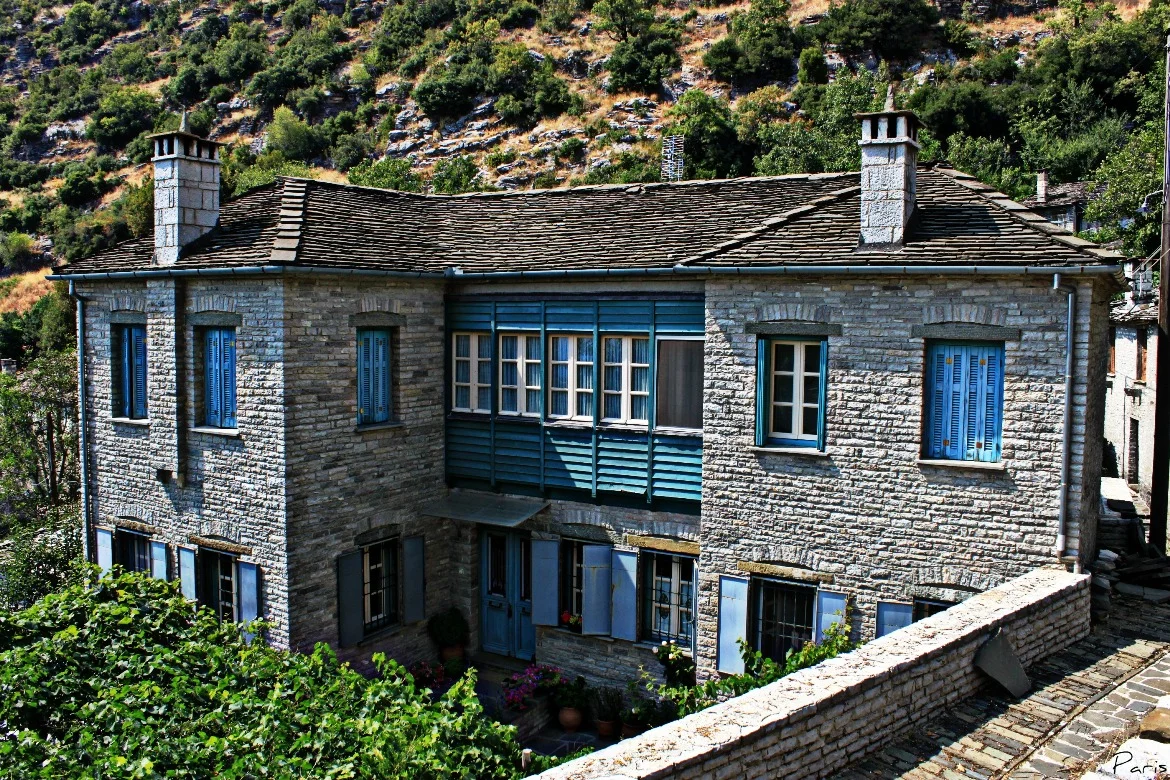
Traditional architecture in Kapesovo
You can begin from the villages of Western Zagori (the name originating from Slavic that translates into “beyond the mountains”), located west of Mt. Tymphe. There you will find the well-preserved and traditional villages of Ano Pedina with the Monastery of Evangelistria and Vitsa with the Skala of Vitsa leading to the double-arched bridge of Misios. Then you may visit Kato Pedina, Monodendri with the Rizario Centre of Handicrafts and the Monastery of Agia Paraskevi, Elafotopos, Aristi with the Monastery of Panagia Spileotissa, Vikos, Papingo and Mikro Papingo, the two most popular villages of the region located in the Vikos-Aoos national park.
Your journey moves on to Central Zagori, between Tymphe and Mitsikeli mountains, where the villages are the result of exceptional architecture and long-lasting tradition. Those are Asprageli, Dilofo (built between two hills, hence the name), Koukouli, Dikorfo (meaning two peaks in Greek), Kapesovo, Tsepelovo, Vradeto and many more.

Bridge of Kalogeriko in Zagorochoria
Last but not least, your journey should finish by visiting Eastern Zagori, located between Mitsikeli and Pindos, another sample of the Zagori region’s reputation and magnificence. Known for its villages- like Tristeno, Greveniti or Doliani- of paramount attraction, you will be satisfied by the panoramic view and the never-ending possibilities this place “beyond the mountains” has to offer you if you get excited by something more alternative.
2. Kalamata: the grandeur between Mt. Taygetos and the Gulf of Messinia

Boats lying at Kalamata port
The timeless city of Kalamata has a lot to offer: the bright blue sea, the magnificence of Mt. Taygetos and the opportunity to wander around the heart of the city. Kalamata combines both the modern element and the history and culture dating back to the ancient times. These are just a few of the things you will see and experience during your visit in Kalamata.
One of the biggest cities of the Peloponnese peninsula, Kalamata is the ideal place for those who want to enjoy the beaches’ endless possibilities in summer and the natural beauty of Mt. Taygetos all year long. Whether on a family trip or with friends -or just your significant other- you will see modern and traditional cafes and restaurants, historic buildings, markets, the port and much more, while the nightlife is alive and thriving throughout the year.

Ancient Messene in Peloponnese
For the history enthusiasts, Kalamata is considered the perfect destination, as history can be discovered on every street corner and every building. You can start by visiting the Kalamata Castle dating back to the 13th century. Then, there is the Benakeion Archaeological Museum, located right in the center of the city and near the Church of Ypapanti, as well as the Historical and Folk Art Museum, the neoclassical building of the Municipal Gallery and the Church of Agii Apostoli. If you are more interested in ancient times, then Ancient Messene is a must.
Just 25 kilometers north of Kalamata, you will come across the Odeon, parts of the fortified wall that surrounded the region, the theatre, the stadium, the propylaeum of the market and the Bouleuterion (council house/chamber). Last but not least, in order to witness the architectural magnificence of Iktinos (the architect of the Parthenon), you should visit the Temple of Apollo Epicurius, which can be accessed by car or bus, two hours north from Kalamata.
Interested in exploring Peloponnese and its wine culture?

3. Volos: tsipouro and meze right by the sea

Traditional architecture in Pelio
Usually, when talking of Volos, the first thing that pops in mind is the local taverns and restaurants that spread all over the city. To fully experience your travel in Volos, you have to first taste, then see. It is a city of uncanny beauty that bridges the old and the modern element, brings you the greatest culinary tradition, takes hospitality to a new level and is just a breath away from the picturesque villages of Pelion.

Volos characteristic stone buildings
What to do first is a question that needs no answer. You should start with a walk alongside the waterfront, where you will find the majority of the cafes and taverns, locally better known as tsipouradika. Lined next to each other, they are full of people enjoying their coffee throughout the day or drinking a quick tsipouro and tasting the rich meze before they head home after work. Among the sights, you will find the sculpture of Argo, the neoclassical building of the National Bank of Greece, the Railway Museum, the Achilleon theatre and the prehistoric settlements of Dimini and Sesklo; and don’t forget to walk along the promenade, the so-called Kordoni, offering a perfect view of the Alykes region opposite the city centre.

Lighthouse in Pelio
To see exactly what Volos is all about, then your next destination is the area of Palia, as called by the locals. There you will find a plethora of tsipouradika, mainly filled with students of the local university that wish to hang out with their friends and loosen up from the university everyday life, and pubs for beer-lovers.

Magnificent view of Portaria village
Your stay in Volos should also include a visit to the scenic and traditional villages on the mountain Pelion. Zagora, Keramidi, Mouresi, Pouri, Milies, Agios Lavrentios, Makrinitsa, Portaria, Tsangarada are some of the villages found on the mountain Pelion, that, according to Greek mythology, were ruled by Centaurs. It might be October, but it is worth finding your way to the unparalleled beaches of Pagasitikos gulf and then to the dense forests surrounding each village, painted in the surreal colors of autumn and covered by paths, stone fountains and the finest houses. These villages, the jewels of Pelion, bring together a unique architecture, local tradition, and a spectacular view, along with the incomparable natural beauty of the region.
4. Thessaloniki: the city of history, culture, and modernity with a traditional twist

White tower in Thessaloniki during sunset time
The second largest city of Greece, located in Macedonia, Thessaloniki is the city that brings together different worlds, cultures and mentalities and the city where travelers have the chance to explore various eras all gathered in one place.
To experience the true identity of the city, you should begin from the iconic White Tower that graces the city’s waterfront and has become the trademark of Thessaloniki standing there since the 16th century. Next destination on your to-do list are the sights dating back to the Roman times and the reign of Emperor Galerius, the Palace, the Triumphal Arch, celebrating a victory against the Persians, the Rotunda and north of Aristotelous square the Roman Agora (forum); or if you are more into museums, then you shouldn’t skip the Archaeological Museum, where major prehistoric and ancient Macedonian and Hellenistic findings can be found. The Byzantine Museum, on the other hand, houses plenty of treasures of the Byzantine era and introduces the visitor to its history.

The umbrella installation at Thessaloniki's marina
Next part of your visit is the Church of Agios Dimitrios, the patron saint of Thessaloniki. The enormous structure of the 5th century AD honors the death of martyr Dimitrios, a Roman soldier, by Emperor Galerius, a persecutor of Christians. Carrying on in one of the oldest parts of the city, Ano Poli, you will be able to admire the Byzantine churches of Osios David and Agios Nikolaos Orfanos, the Vlatades monastery, the Eptapyrgio fortifications (Yedi Kule) and other monuments from the Ottoman and Roman periods.

Rotunda in Thessaloniki
However, what you should never leave out from your visit in Thessaloniki is the lively and vibrant nightlife. The numerous bars and clubs, traditional tavernas and restaurants that spread all over the city, many of them located in the well-known area of Ladadika, give the opportunity to the traveler to encounter the locals’ authentic way of living. You should also taste the multicultural gastronomy of Thessaloniki, usually consisting of choices that combine traits of different cuisines that will take this culinary experience to new levels.

5. Nafplio: the Old Town in all its glory

Beautiful colors over Bourtzi in Nafplio
To better explore the city of Nafplio, the first capital of the newly established Greek State between 1823 and 1834, you have to simply walk on its roads, alleys, dromoskales (street-stairs that connect the upper part of the city to the port) and narrow pathways that are all interconnected in the heart of the Old Town. Take a stroll around its squares that have played a significant role in the city’s history.
The Byzantine, Frankish, Venetian, and Ottoman influences are evident all over the city and can be depicted in its culture, tradition, and architecture. Fountains from the Ottoman period, Venetian and neoclassical buildings and the well-preserved paved alleys are the marks that remain intact and bejewel the romantic city of Nafplio. The ancient walls and castles, statues and other monuments can be found on every street corner, making your visit there a constant “treasure hunt”.

Castle of Bourtzi as seen from Nafplio's marina
Once you get there, the first thing to see is the Syntagma Square, where you can admire the impeccable and particular architecture of the surrounding historic buildings and other monuments. When you have taken in the unique beauty of your surroundings, you should visit the first Greek Parliament, housed in one of the two Turkish mosques found in Nafplio. Then head to the Archaeological Museum, where you can find artifacts from the Prehistoric and Mycenaean era, the Municipal Gallery, and of course the churches of Agios Spyridon and Agios Georgios.
Your trip to Nafplio shouldn’t, however, end before visiting Palamidi. After climbing the 999 stairs to reach Palamidi, you might be exhausted, but you will be definitely rewarded by the stunning view of the whole city right at your feet. To perfectly wrap things up, your last destination should be Bourtzi, the fortress built by Venetians on the islet of Agioi Theodoroi.
You may visit Nafplio in our Mycenae, Epidaurus and Nafplio Private Day Tour!
6. Meteora: a destination yet to be explored

Meteora monastery on the top of a cliff
If you’re looking for a place that perfectly combines the majestic scenery created by Mother Earth and the human intervention in an attempt to connect with the Divine, then the impressive region of Meteora is exactly what you’re asking for. The perfect conjunction of nature, history, religion, and architecture can be found just above the town of Kalambaka, at the gigantic rock formations that reach a height of 400 meters and extend between the mountains of Koziaka and Antichasia.

Gigantic rock formations in Meteora
Considered the second “Mount Athos”, it is part of a six-century long monastic tradition, introducing the visitors to a non-conventional side of holidays in Greece, even if you are not deeply interested in religion. From the 24 monasteries built in the solitude and silence of the rocks of Meteora, only six of them are still occupied and open to the public (four of them only allowing men and the other two admitting exclusively women). The rest are abandoned, mainly reminding what is left of their former magnificence.

Meteora: the ideal October getaway in Greece
Meteora is the symbol of man’s eternal struggle and desire to come in contact with God, being the perfect place for those who would like to experience a spiritual elevation, to explore their inner self, offering them the opportunity for a different kind of vacation.
Did you like our post? Pin it!

Have you been in any of the aforementioned places? What is your favorite October getaway in Greece?
Let us know by commenting below!
Words: Spyros Balesias


Location: Cape Sounio & the Athenian Riviera
Duration: 5h (Half-Day tour) - 7-8h (Full-Day tour)
No. of participants: 2-14 persons
Suitable for: 6+ years old
Language: English
Suggested time to start: 7:45 - 8:00 am (also available as Sunset Tour with afternoon starting time)
Cost for the Half-Day tour: 280€ (1 to 3 persons), 320€ (4 to 7 persons), 400€ (8 to 14 persons)
Cost for the Full-Day tour: 350€ (1 to 3 persons), 390€ (4 to 7 persons), 470€ (8 to 14 persons)
Description
A road trip to Cape Sounio is an amazing scenic drive along the coastline, the famous Athenian Riviera. Standing at the very top of Cape Sounio, the photogenic temple of Poseidon is considered a masterpiece of the golden age of Athens and one of the most spectacular templesall over Greece. If you choose to do the tour in the afternoon (instead of the suggested morning time), you will see one of the most beautiful sunsets, with the sun washing the sky in reds, pinks and oranges as it sets into the sea.
During our drive towards Cape Sounio you will have the opportunity to experience the seashore firsthand while you admire the amazing views. Athens is actually one the few cities in Europe with such a long coastline within the greater metropolitan area. In the extended version of this tour (9h) visitors will also have the opportunity to enjoy the beautiful clear waters of the sea as a stop for swimming and relaxing at one of the picturesque beaches found along the way is included in the schedule. The participants of both HD and FD tour will also visit the Vouliagmeni lake with its massive cave systems, a hidden treasure of Attica's nature. This hot-springs-fed lake, situated just a few meters away from the sea, is set dramatically against a huge jutting offering a landscape of unique beauty to all visitors.
There are several myths and legends about the Cape Sounio and the temple of Poseidon. Whether the stories related to this place are real or just myths, there is no doubt that once you visit the area you will feel the gloriousness of the site and enjoy one of the most spectacular views of the Aegean Sea.
This tour is ideal for visitors who want to combine sun, sea and culture during their stay in Athens.
Highlights
Drive along Athens coastline and enjoy the view along the ride.
See Vouliagmeni Lake, a natural spa next to the sea.
Visit Cape Sounio, a magnificent picture-perfect spot overlooking the Aegean sea.
Admire the Temple of Poseidon, an architectural jewel of Ancient Greece.
Swim at the beautiful waters of the Athenian Riviera (Full-Day tour only)
Take a break for lunch/dinner (Full-Day tour only).
What's included
Hotel pick-up & private transfer with taxi or van (upon availability) to Sounio and Temple of Poseidon.
Professional English-speaking driver. Please note that the driver is not a licensed tour guide*.
Fuel costs, tolls, vehicle insurance and parking fees.
Swimming at the beach (only in the full-day version).
What’s not included
Entrance fees of Archaeological Sites (Temple of Poseidon), gratuities, lunch/dinner costs, other client personal expenses.
Licensed Tour Guide.
Anything not mentioned in the “What’s included” section.